Questions Related to biology

Multiple choice biology reproduction in humans twins reproduction and modern technology post fertilization events

What are identical twins?

  1. Heterozygous

  2. Homozygous

  3. Monozygotic

  4. Dizygotic

Reveal answer Fill a bubble to check yourself
C Correct answer
Explanation

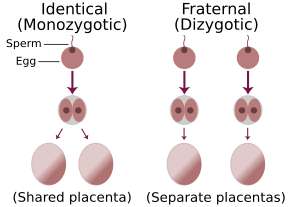
Image result for monozygotic identical twin
Twins are two offsprings produced by the same pregnancy. Twins can either be monozygotic (identical twin), meaning that they develop from one zygote that splits and forms two embryos, or dizygotic (fraternal twin), which are produced from two eggs. Thus, the correct answer is option C.

Multiple choice biology reproduction in humans twins reproduction and modern technology post fertilization events

Which are the two offspring developed in the same uterus but from fertilization of two different ova?

  1. Dizygotic twins

  2. Monozygotic twin

  3. Fraternal twins

  4. Both A and C

Reveal answer Fill a bubble to check yourself
D Correct answer
Explanation

Dizygotic twins may occur if two or more oocytes are released in one cycle. If each is fertilized, dizygotic twins may result. Fertility drugs are a common cause for dizygotic twins, but other factors, like family history, maternal age or weight, can also lead to dizygotic twinning. Thus, the correct answer is option D.

Multiple choice biology reproduction in humans twins reproduction and modern technology post fertilization events

Monozygotic twins develops from

  1. Different zygotes

  2. Different ova

  3. Different sperms

  4. Same zygote

Reveal answer Fill a bubble to check yourself
D Correct answer
Explanation

  • There are two types of twins, Fraternal or dizygotic twins, and monozygotic twins.
  • When the zygote, during the cleavage, separates and forms two different cells and both of them grow individually as embryos, they form the monozygotic twins.
  • Monozygotic twins are of the same sex.
  • When 2 zygotes are fertilized by two different sperms they form the dizygotic twins.
  • They can be of different sex.

So, the correct option should be 'Same Zygote'.

Multiple choice biology reproduction in humans twins reproduction and modern technology post fertilization events

Concordant type of twins are

  1. Free martins

  2. Dizygotic twins

  3. Monozygotic twins

  4. Both B and C

Reveal answer Fill a bubble to check yourself
C Correct answer
Explanation
Monozygotic or identical twins are those twins which are formed by the splitting of one zygote into two embryos. They have almost the same characteristics both phenotypically and genotypically. Dizygotic or fraternal twins are formed when two different eggs are fertilized by two different sperms.
so, the correct option is ' Monozygotic twins'.
Multiple choice need of water transport in plants biology

The vascular tissue that transports food in different parts of plants is

  1. Phloem

  2. Xylem

  3. Blood

  4. Leaves

Reveal answer Fill a bubble to check yourself
A Correct answer
Explanation

Blood is absent in plants.

Leaf is where synthesis of food takes place.
The transport tissues in plants are xylem and phloem.

Xylem transports water and minerals from the roots to other parts of plants.
Phloem transports food in different parts of the plants.

So the correct answer is 'Phloem'.

Multiple choice need of water transport in plants biology

Choose the wrongly matched pair w.r.t. pathway of water absorption.


Apoplast pathway Symplast pathway
$(1)$ Involves intercellular spaces and cell wall Involves interconnected protoplasts
$(2)$ Water movement by cytoplasmic streaming Water movement by mass flow
$(3)$ Fast water movement Slow water movement
$(4)$ Occurs in epidermis and cortex Occurs in endodermis

  1. 1

  2. 2

  3. 3

  4. 4

Reveal answer Fill a bubble to check yourself
B Correct answer
Explanation
Answer is 2.
In symplast - Water movement by cytoplasmic streaming.
In apoplast-Water movement by mass flow. 
Multiple choice need of water transport in plants biology

Select the incorrect statements
(a) Older dying leaves export most of their mineral content to younger leaves
(b) Sulphur and calcium are frequently remobilised from senescing parts
(c) lons are absorbed from the soil by both passive and active transport
(d) A $C _3$ plant loses only half as much water as a $C _4$ plant for the same amount of $CO _2$ fixed

  1. (a), (b) and (c)

  2. Only (a) and (c)

  3. Only (b) and (d)

  4. All except (c)

Reveal answer Fill a bubble to check yourself
C Correct answer
Explanation

Statement b is incorrect because calcium is largely structural and not remobilised from senescing parts. Statement d is incorrect because C3 plants actually lose twice as much water as C4 plants for the same amount of CO2 fixed, not half. Therefore, statements b and d are incorrect.

Multiple choice need of water transport in plants biology

Aquaporins are transport channels, which

(I) Are found in both plants and animals
(II) Allow for faster water movement between the cells than osmosis
(III) Allow water molecules to pass during transpiration
(IV) Do not open during drought stress

  1. III and IV

  2. Only II

  3. Only III

  4. I and II

Reveal answer Fill a bubble to check yourself
D Correct answer
Explanation

Aquaporins are integral membrane proteins that form pores in the membrane of biological cells, mainly facilitating transport of water between cells. The cell membranes of a variety of different bacteria, fungi, animal and plant cells contain aquaporins through which water can flow more rapidly into and out of the cells than by diffusing through the phospholipid bilayer.  


so the correct option is " I and II'.

Multiple choice need of water transport in plants biology

In plants water moves from ________________.

  1. Less negative to more negative gradient

  2. More negative to less negative gradient

  3. Similar gradient

  4. Zero gradient

Reveal answer Fill a bubble to check yourself
A Correct answer
Explanation

Water potential moves from a region of higher water potential (less negative) to a region of lower water potential (more negative).

Multiple choice need of water transport in plants biology

The passage of water and minerals is confirmly symplast in -
  1. Cortical layers

  2. Epidermis

  3. Endodermis

  4. xy cavity

Reveal answer Fill a bubble to check yourself
A Correct answer
Explanation

The symplastic pathway involves the movement of water and minerals through the cytoplasm of interconnected plant cells via plasmodesmata. Cortical cells are connected in this way, allowing for symplastic transport.