Biology

Genetics and Plant Breeding

1,177 Questions

Genetics and Plant Breeding explores the principles of heredity, chromosomal inheritance, and hybridization techniques. It includes key concepts like Mendelian genetics, gene linkage, and polygenic inheritance. This topic is essential for students tackling advanced biology or botany sections in competitive examinations.

Mendelian InheritanceChromosome TheoryGene LinkagePolygenic InheritancePlant HybridizationPopulation Genetics Equilibrium

Genetics and Plant Breeding Questions

Multiple choice botany classical genetics non mendelian inheritance deviation from mendelism genetics

Which of the following is not the Mendel's principle of inheritance?

  1. Law of incomplete dominance

  2. Law of dominance

  3. Law of segregation

  4. Law of independent assortment

Reveal answer Fill a bubble to check yourself
A Correct answer
Explanation

Incomplete dominance is a form of intermediate inheritance in which one allele for a specific trait is not completely expressed over its paired allele. In the early 1900s, German botanist Carl Correns (1864–1933) would conduct similar research on four o'clock plants. While Mendel's work laid a foundation, it isCorrens who is credited with the actual discovery of incomplete dominance. In his work, Correns observed a blend of colors in flower petals. So, the correct option is 'Law of incomplete dominance'.

Multiple choice botany classical genetics non mendelian inheritance deviation from mendelism genetics

$F _2$ generation in a Mendelian cross showed that both genotypic and phenotypic ratio are same as 1 : 2 : 1. It represents a case of  

  1. Monohybrid cross with complete dominance

  2. Monohybrid cross with incomplete dominance

  3. Co-dominance

  4. Dihybrid cross

Reveal answer Fill a bubble to check yourself
B Correct answer
Explanation

Incomplete dominance is a type of intermediate inheritance in which one allele is not completely dominant over its paired allele. In this, the third phenotype is observed in heterozygous condition. In monohybrid cross with incomplete dominance, the phenotypic and genotypic ratio is 1:2:1, where one part is with dominant phenotype, 2 parts are with intermediate phenotype and 1 part is with recessive phenotype. For example, a snapdragon flower shows red (dominant), white (recessive) and pink (intermediate) flowers.

Thus, the correct answer is 'Monohybrid cross with incomplete dominance.'

Multiple choice botany classical genetics non mendelian inheritance deviation from mendelism genetics

In Mirabilis jalapa , the percentage of plants having pink and red flowers would be ________ when pink flower plant is test crossed.

  1. 25% pink and 25% red

  2. 50% pink and 50% red

  3. 50% pink and 0% red

  4. 0% pink and 50% red

Reveal answer Fill a bubble to check yourself
B Correct answer
Explanation
 Gamete  R
 r Rr- Pink flower  rr- White flower 

Mirabilis jalapa is a plant showing incomplete dominance which means that when in F$ _1$ generation intermediate phenotype appears instead of the two parent phenotypes. 

While, the test cross is defined as a cross between an F$ _1$ plant and the homozygous recessive parent.
So, for plants to be pink in Mirabilis jalapa the plant has to be Rr in genotype. (where R is dominant on r while RR gives Red color and rr gives white color flowers in a plant).
Desired cross: Rr x rr 
So, the phenotype ratio is: 1:1::Pink flower:White flower
So, the correct answer is '50% pink and 50% red'.

Multiple choice botany classical genetics non mendelian inheritance deviation from mendelism genetics

Different forms of a gene are called

  1. Heterozygotes

  2. Alleles

  3. Complementary genes

  4. Supplementary genes

Reveal answer Fill a bubble to check yourself
B Correct answer
Explanation

A.Heterozygotes – Organisms with a pairs of contrasting characters are called Heterozygotes.

B.Alleles - An alternative form of a character in a pair, controlled by a single gene is called Allele. It is dominant either in homozygous or heterozygous state.

C.Complementary gene – Two genes present on separate loci that interact together to produce a dominant phenotype is called Complementary gene. In the F2 generation 9:7 ratio.

D.Supplementary gene – genes which include two pairs of non-allelic genes. Both of them are involved in affecting the same character. Out of the non-allelic genes, one gene is dominant and can express by itself. Second gene is also dominant but expresses only when it is supported by the presence of the first gene. In the F2 geneartion 9:3:4 ratio.

So, the correct option is ‘Alleles’. 

Multiple choice botany classical genetics non mendelian inheritance deviation from mendelism genetics

A cross between yellow flowered and round fruit (both dominant) bearing plant and white flowered elongated fruit (both recessive) bearing plant yielded 20 plants in $F _1$ progeny which formed 960 plants in $F _2$ generation. The number of plants with yellow flowers and round fruits in $F _1$ and $F _2$ generations would be

  1. 20, 960

  2. 20, 540

  3. 10, 180

  4. 10, 60.

Reveal answer Fill a bubble to check yourself
B Correct answer
Explanation

class=A cross is made between pure yellow flowered  and round fruit(YYRR) with white flowered elongated fruit(yyrr). In the F1 generation 20 progeny with yellow flowered and round fruits(YyRr) are formed. When they are subjected to self pollination followed by self fertilization, in the F2 generation, 960 progeny are formed. In these 540 plants are yellow flowered round fruits, plants are yellow flowered elongated fruits, 180 fruits are white flowered round fruits and 60 plants are white flowered elongated fruits the correct option is 20, 540

Multiple choice botany classical genetics non mendelian inheritance deviation from mendelism genetics

Two plants of Summer Squash both having circular fruits are crossed. $F _1$ plants had discoid fruits. $F _2$ generation has 3 types of fruits, discoid, circular and long in the ratio of

  1. 9 : 3 : 4

  2. 9 : 6 : 1

  3. 12 : 3 : 1

  4. 7 : 6 : 3

Reveal answer Fill a bubble to check yourself
B Correct answer
Explanation

This is a classic example of duplicate recessive epistasis in Summer Squash fruit shape. The F2 ratio for this type of interaction is 9:6:1, where 9 are discoid, 6 are circular, and 1 is long.

Multiple choice botany classical genetics non mendelian inheritance deviation from mendelism genetics

A modified dihybrid mendelian ratio of 9 : 3 : 4 indicates

  1. Supplementary genes

  2. Complementary genes

  3. Lethal genes

  4. Epistalic genes

Reveal answer Fill a bubble to check yourself
A Correct answer
Explanation

A.Supplementary genes – A pair of non allelic genes, one of which produces its effect independently in the dominant state while the dominant allele of the second gene is without any independent effect but is able to modify the effect of the former to produce to a new trait are called Supplemetary genes. Due to these genes in the F2 generation, 9:3:4 ratio of progeny are obtained. It is a modified Mendel dihybrid ratio.

B.Complementary genes – Two genes present on separate loci that interact

together to produce dominant phenotypic character; neither of them if present alone can express itself are called complementary genes. Due to these genes in the F2 generation, 9:7 ratio of progeny are obtained. It is a modified Mendel dihybrid ratio.

C.Lethal genes – A pair of genes present in the homozygous conditions, causes the death of the individual are called Lethal genes. Due to the genes, in F2 generation 2:1 ratio of progeny are obtained.

D.Epistatic genes – A gene which masks the action of another gene is termed as epistatic gene and process is called epistasis. Due to these genes in the F2 generation, either 9:3:4  or 12.3.1 ratio of progeny are obtained. It is a modified Mendel dihybrid ratio.

So, the correct option is ‘supplementary genes’.     

Multiple choice biology reproduction in humans twins reproduction and modern technology post fertilization events

Genetically identical human progeny is produced when an individual

  1. Practices cross fertilization

  2. Produces identical gametes

  3. Undergoes mutation

  4. Practices by breeding without meiosis

Reveal answer Fill a bubble to check yourself
B Correct answer
Explanation

The production of a new individual organism or offspring from the parents is the result of a process called reproduction which can be sexual or asexual. In the case of sexual reproduction, the offsprings tend to carry the genetic information from both the parents which are contained in genes carried by chromosomes. Sexual reproduction produces offspring that resemble their parents but are not identical to them but asexual reproduction does not involve mixing of genetic information and hence tend to give rise to genetically identical  progeny. In the case of human beings, this take place either due to natural cloning where there is the production of identical gametes.

Multiple choice biology reproduction in humans twins reproduction and modern technology post fertilization events

Identical twins are born when

  1. Two ova crosses with two sperms

  2. One ovum crosses with one sperm

  3. Two sperms crosses with one ovum

  4. None of the above

Reveal answer Fill a bubble to check yourself
B Correct answer
Explanation

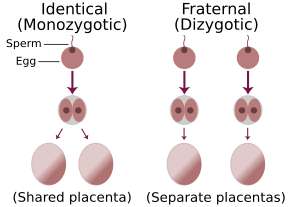
Identical twins are born when one ovum crosses with one sperm to form one zygote (monozygotic). This zygote later divides into two embryos. These embryos share the same womb. Non-identical twins are born when two ova crosses with two sperms at the same time to form two zygotes (dizygotic).

Thus, the correct answer is option B.

Multiple choice biology reproduction in humans twins reproduction and modern technology post fertilization events

Identical twins are

  1. Twins of different sex

  2. Twins from a single egg

  3. Twins from two eggs that have been fertilized by the same sperm

  4. Twins from two eggs fertilized by two separate sperm

  5. Twins from a single egg fertilized by two separate sperm

Reveal answer Fill a bubble to check yourself
B Correct answer
Explanation

When one fertilized egg splits and develops into two embryos with the same genetic information is called as identical twins. It is also called as monozygotic as the single zygote is involved in the formation of two embryos. Whereas dizygotic twins are called as fraternal twins in which two zygotes are involved in the formation of two embryos. Thus, the correct answer is option B.

Multiple choice biology reproduction in humans twins reproduction and modern technology post fertilization events

Fraternal twins are derived from.

  1. Single fertilized egg

  2. Two separate fertilized eggs present in the same womb

  3. An ovum fertilized twice followed by its breaking

  4. Breaking of one unfertilized egg and fertilization of both parts

Reveal answer Fill a bubble to check yourself
B Correct answer
Explanation

Fraternal or dizygotic twins develop when two separate eggs are fertilized by two separate sperm cells during the same ovulatory cycle, resulting in two distinct zygotes in the womb.

Multiple choice biology reproduction in humans twins reproduction and modern technology post fertilization events

What are identical twins?

  1. Heterozygous

  2. Homozygous

  3. Monozygotic

  4. Dizygotic

Reveal answer Fill a bubble to check yourself
C Correct answer
Explanation

Image result for monozygotic identical twin
Twins are two offsprings produced by the same pregnancy. Twins can either be monozygotic (identical twin), meaning that they develop from one zygote that splits and forms two embryos, or dizygotic (fraternal twin), which are produced from two eggs. Thus, the correct answer is option C.

Multiple choice biology reproduction in humans twins reproduction and modern technology post fertilization events

Monozygotic twins develops from

  1. Different zygotes

  2. Different ova

  3. Different sperms

  4. Same zygote

Reveal answer Fill a bubble to check yourself
D Correct answer
Explanation

  • There are two types of twins, Fraternal or dizygotic twins, and monozygotic twins.
  • When the zygote, during the cleavage, separates and forms two different cells and both of them grow individually as embryos, they form the monozygotic twins.
  • Monozygotic twins are of the same sex.
  • When 2 zygotes are fertilized by two different sperms they form the dizygotic twins.
  • They can be of different sex.

So, the correct option should be 'Same Zygote'.