Tag: amphibolic pathway

Questions Related to amphibolic pathway

Multiple choice biology life processes in living organisms- part 1 amphibolic pathway living organisms and energy production respiration in plants

Which of the following forms the connecting link between glycolysis and Kreb's cycle?

  1. Glucose

  2. Ethyl alcohol

  3. Lactic acid

  4. Pyruvic acid

Reveal answer Fill a bubble to check yourself
D Correct answer
Explanation
Pyruvic acid is produced as a final end product of glycolysis. This pyruvic acid then forms acetyl CoA. This acetyl CoA, acts as initial compound of Kreb's cycle.
So, the correct answer is 'Pyruvic acid'
Multiple choice biology respiration in plants amphibolic pathway living organisms and energy production life processes in living organisms- part 1

The details of tricarboxylic acid pathway was worked out by

  1. Miescher

  2. Hans Krebs

  3. Pasteur

  4. None of the above

Reveal answer Fill a bubble to check yourself
B Correct answer
Explanation

Sir Hans Adolf Krebs was a German born British physician and biochemist. He was the pioneer scientist in study of cellular respiration, a biochemical pathway in cells for production of energy.

Multiple choice biology respiration in plants amphibolic pathway living organisms and energy production life processes in living organisms- part 1

Out of 38 molecules of ATP produced after aerobic respiration of glucose, the break up in ATP production in glycolysis (P). pyruvic acid to acetyl CoA formation (Q) and Krebs cycle (R) is 

  1. P = 2, Q = 6, R = 30

  2. P = 8, Q = 6, R = 24

  3. P = 8, Q = 10, R = 20

  4. P = 2, Q = 12, R = 24

Reveal answer Fill a bubble to check yourself
B Correct answer
Explanation

Glycolysis produces 8 ATP (2 net ATP + 2 NADH yielding 6 ATP via shuttle), link reaction produces 6 ATP (2 NADH), and the Krebs cycle produces 24 ATP (6 NADH, 2 FADH2, 2 GTP/ATP). The total is 38 ATP.

Multiple choice biology respiration in plants amphibolic pathway living organisms and energy production life processes in living organisms- part 1

Aerobic respiratory pathway is appropriate termed ___________.

  1. Anabolic

  2. Catabolic

  3. Amphibolic

  4. Parabolic

Reveal answer Fill a bubble to check yourself
C Correct answer
Explanation

Respiration is called amphibolic because it involves both catabolic processes (breakdown of substrates to release energy) and anabolic processes (use of respiratory intermediates for biosynthesis).

Multiple choice biology respiration in plants amphibolic pathway living organisms and energy production life processes in living organisms- part 1

Which of the two statements together support that respiratory pathway is an amphibolic pathway.
i) Fats breakdown to glycerol and fatty acids, subsequently yields acetyl CoA
ii) In respiration C-C bonds of complex compounds breakdown through oxidation leading to release of energy
iii) Acetyl CoA from respiratory pathway is withdrawn for synthesis of fatty acids
iv) Proteins are degraded by protease to amino acids and enter the respiratory pathway

  1. i, ii

  2. i, iv

  3. ii, iv

  4. ii, iii

Reveal answer Fill a bubble to check yourself
D Correct answer
Explanation

Statement ii describes the catabolic nature (breakdown of C-C bonds), while statement iii describes the anabolic nature (withdrawal of intermediates like Acetyl CoA for fatty acid synthesis), together defining the amphibolic pathway.

Multiple choice biology respiration in plants amphibolic pathway living organisms and energy production life processes in living organisms- part 1

Largest amount of phosphate bound energy is produced in the process of respiration during 

  1. Anaerobic respiration

  2. Glycolysis

  3. Krebs cycle

  4. None of the above

Reveal answer Fill a bubble to check yourself
C Correct answer
Explanation

During the process of glycolysis 8 ATP molecules are produced in aerobic respiration. In the case of Krebs cycle 30 ATP molecules can be produced.

Multiple choice biology respiration in plants amphibolic pathway living organisms and energy production life processes in living organisms- part 1

The process by which the energy of glucose is released under aerobic respiration was discovered by

  1. Hopkins

  2. Lister

  3. Krebs

  4. Pasteur

Reveal answer Fill a bubble to check yourself
C Correct answer
Explanation

The process by which the energy of glucose is released under aerobic respiration, was discovered by Hans Krebs. The Krebs cycle is a part of cellular respiration. It is a series of chemical reactions used by all aerobic organisms to generate energy.

Multiple choice biology respiration in plants amphibolic pathway living organisms and energy production life processes in living organisms- part 1

Aerobic respiratory pathway is appropriately called as

  1. Anabolic

  2. Catbolic

  3. Amphibolic

  4. Parabolic

Reveal answer Fill a bubble to check yourself
C Correct answer
Explanation

Aerobic respiratory pathway is appropriately called amphibolic pathway. It contains both catabolic and anabolic reactions. The pathway is catabolic because in this pathway, glucose is broken down into carbon dioxide and water. It is also anabolic pathway as energy rich ATP molecule is produced during this pathway. These ATP molecules are later used to carry out various reaction. 

Thus, the correct answer is option C.

Multiple choice biology respiration in plants amphibolic pathway living organisms and energy production life processes in living organisms- part 1

Kerbs cycle __________________.

  1. Liberates a minor part of energy during respiration

  2. Is operative in photorespiration

  3. Reactions are independent of oxygen supply

  4. Is a like between carbohydrate and nitrogen metabolism

Reveal answer Fill a bubble to check yourself
A Correct answer
Explanation

The Krebs cycle is a major metabolic pathway that releases energy in the form of NADH, FADH2, and ATP/GTP. While it is a central hub, it is primarily responsible for the oxidation of acetyl-CoA.

Multiple choice biology respiration in plants amphibolic pathway living organisms and energy production life processes in living organisms- part 1

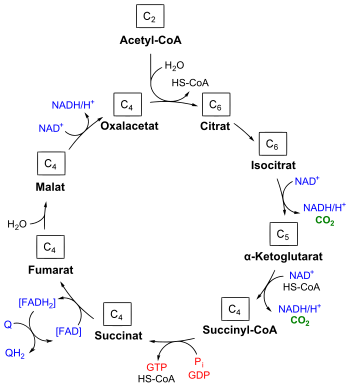
In Kreb's cycle, OAA accepts acetyl CoA to form 
  1. Citric acid

  2. Oxalosuccinate

  3. Fumarate

  4. Succinyl CoA

Reveal answer Fill a bubble to check yourself
A Correct answer
Explanation

The citric acid cycle starts with the condensation of acetyl group with oxalo acetic acid and water to yield citric acid. The reaction is catalysed by the enzyme citrate synthase and a molecule of CoA is released.

Image result for citric acid cycle
So the correct option is 'citric acid'.