Physics · Science General

Optics and Light Properties

2,019 Questions

Optics and light properties focus on the behavior of light, including reflection, refraction, dispersion, and polarization. This topic also covers the wave nature of light, illumination, and the functioning of optical instruments like microscopes. Questions on these concepts are common in general science sections of SSC, Railways, and State exams.

Reflection and mirrorsRefraction and mediumsLight wave theoriesPolarization and intensity

Optics and Light Properties Questions

Multiple choice physics option a: relativity maxwell's equations the nature of light introduction to electromagnetic waves

Which of the following effects could not be explained by Maxwell's electromagnetic wave theory?

  1. Photoelectric effect

  2. Compton effect

  3. Raman effect

  4. All of these

Reveal answer Fill a bubble to check yourself
D Correct answer
Explanation

  1. Photoelectric effect was discovered by heinrich Rudoy Hertz.
  2. Compton effect was discovered by Aethur Holl Compton.
  3. Raman effect was discovered by Sir Chandrasekhar Venbata Ram. 
      So, none of these effect was discovered by Maxwell.

Multiple choice physics option a: relativity maxwell's equations the nature of light introduction to electromagnetic waves

Unpolarized light falls first on polarizer $\left( P \right) $ and then on analyzer $\left( A \right) $. If the intensity of the transmitted light from the analyser is $\dfrac { 1 }{ 8 }$th of the incident unpolarized light. What will be the angle between optic axes of $P$ and $A$?

  1. ${ 45 }^{ o }$
  2. ${ 30 }^{ o }$
  3. Zero

  4. ${ 60 }^{ o }$
Reveal answer Fill a bubble to check yourself
D Correct answer
Explanation

Given,
$I=\dfrac { { I } _{ 0 } }{ 2 } $              ....(i)
${ I }^{ ' }=I\cos ^{ 2 }{ \theta  } $                 $\left( \because { I }^{ ' }=\dfrac { { I } _{ 0 } }{ 8 }  \right) $
$\therefore \dfrac { { I } _{ 0 } }{ 8 } =\dfrac { { I } _{ 0 } }{ 2 } \cos ^{ 2 }{ \theta  } $
From the equation (i), we have
$\dfrac { 1 }{ 4 } =\cos ^{ 2 }{ \theta  } \Rightarrow \cos { \theta  } ={ 1 }/{ 2 }$
$\Rightarrow \cos { \theta  } =\cos { { 60 }^{ o } } $
$\Rightarrow \theta ={ 60 }^{ o }$

Multiple choice physics light : reflection and refraction from plane surface principle of reversibility of path of light image formation by plane mirror refractive index

If refraction index of glass with respect to air is $ _{a}{u} _{g} = \dfrac{3}{2}$, the refraction index of air with respect to glass will be $ _{g}{u} _{a} =$

  1. ${3}/{2}$
  2. ${2}/{3}$
  3. ${1}/{3}$
  4. ${1}/{2}$
Reveal answer Fill a bubble to check yourself
B Correct answer
Explanation
refractive index of glass w.r.t air =${ _{ a }{ \mu  } _{ g }= }\dfrac { 3 }{ 2 } $
then,
refractive index of air w.r.t glass  =$ _{ g }{ \mu  } _{ a }=\dfrac { 1 }{ _{ a }{ \mu  } _{ g } } $

$ _{ g }{ \mu  } _{ a }=\dfrac { 1 }{ _{ a }{ \mu  } _{ g } } =\dfrac { 2 }{ 3 } $
Option B is correct.
Multiple choice physics light : reflection and refraction from plane surface principle of reversibility of path of light image formation by plane mirror refractive index

The refractive index of water with respect to air is $ _{a}{u} _{w}$ and of glass with respect to air is $ _{a}{u} _{g}$. Express the refractive index of glass with respect to water

  1. $\dfrac{ _{a}{u} _{g}}{ _{a}{u} _{w}}$
  2. $\dfrac{ _{g}{u} _{a}}{ _{a}{u} _{w}}$
  3. $\dfrac{ _{a}{u} _{w}}{ _{a}{u} _{g}}$
  4. $\dfrac{ _{a}{u} _{a}}{ _{g}{u} _{g}}$
Reveal answer Fill a bubble to check yourself
A Correct answer
Explanation

Refractive index of water w.r.t air
$ _{a}\mu _{w}=\dfrac{\mu _{w}}{\mu _{a}}$
Refractive index of glass w.r.t air
$ _{a}\mu _{g}=\dfrac{\mu _{g}}{\mu _{a}}$
Hence refractive index of glass w.r.t water
$ _{w}\mu _{g}=\dfrac{\mu _{g}}{\mu _{w}}   =\dfrac{ _{a}\mu _{g}}{ _{a}\mu _{w}}$

Multiple choice physics light : reflection and refraction from plane surface principle of reversibility of path of light image formation by plane mirror refractive index

At ray of light is incident in medium 1 at an angle of $37^{o}$ and gets refracted in medium 2 at an angle of $53^{o}$. What will be angle of refraction if light is incident in medium 2 at an angle of $53^{o}$.

  1. $37^{o}$
  2. $53^{o}$
  3. $36^{o}$
  4. $45^{o}$
Reveal answer Fill a bubble to check yourself
A Correct answer
Explanation

Principle of reversibility states that when final path of a ray of light after any number of reflections and refractions is reversed, the ray retraces its entire path or in simple words, light follows exactly the same path if its path of travel is reversed.

Thus angle of refraction of light in medium $1$ will be $37^o$.

Multiple choice physics light : reflection and refraction from plane surface principle of reversibility of path of light image formation by plane mirror refractive index

When a ray of light enters a medium of refractive index $\mu $ from air. It is observed that the angle of refraction is half the angle of incidence. The angle of incidence is :

  1. $2 cos^{-1}(\frac{\mu }{2})$
  2. $ cos^{-1}(\frac{\mu }{2})$
  3. $2 cos^{-1}(\mu )$
  4. $2 sin^{-1}(\frac{\mu }{2})$
Reveal answer Fill a bubble to check yourself
C Correct answer
Multiple choice physics light : reflection and refraction from plane surface principle of reversibility of path of light image formation by plane mirror refractive index

Refractive index of diamond with respect to glass is $1.6$ and absolute refractive index of glass is $1.5$. Find out the absolute refractive index of diamond.

  1. $1.06$
  2. $0.93$
  3. $2.4$
  4. $0.75$
Reveal answer Fill a bubble to check yourself
C Correct answer
Explanation
Given,

Refractive index of diamond with respect to glass, ${ _{ g }{ n } _{ d } } = 1.6$,

Absolute refractive index of glass, $n _{g} = 1.5$

Refractive index of diamond with respect to glass $= \dfrac {\text {Absolute refractive index of diamond}}{\text {Absolute refractive index of glass}}$

Therefore, absolute refractive index of diamond $=$ Refractive index of diamond with respect to glass $\times$ Absolute refractive index of glass $= 1.6 \times 1.5 = 2.4$
Multiple choice physics light : reflection and refraction from plane surface principle of reversibility of path of light image formation by plane mirror refractive index

The refractive index of water is $\dfrac{4}{3}$ and of glass is $\dfrac{3}{2}$. What will be the refractive index of glass with respect to water?

  1. $9.1$
  2. $2.623$
  3. $1.125$
  4. $1$
Reveal answer Fill a bubble to check yourself
C Correct answer
Explanation
refractive index of water =${ _{ a }{ \mu  } _{ w }= }\dfrac { 4 }{ 2 } $
refractive index of glass = ${ _{ a }{ \mu  } _{ g }= }\dfrac { 3 }{ 2 } $

then refractive index of glass w.r.t. water is
$ _{ w }{ \mu  } _{ g }= _{ a }{ \mu  } _{ g }\times \dfrac { 1 }{ _{ a }{ \mu  } _{ w } } $
${ _{ w }{ \mu  } _{ g }= _{ a }{ \mu  } _{ g }\times \dfrac { 1 }{ _{ a }{ \mu  } _{ w } } =\dfrac { 3 }{ 2 } \times \dfrac { 3 }{ 4 } =\dfrac { 9 }{ 8 } =1.125 }$

Option C is correct.


Multiple choice physics light : reflection and refraction from plane surface principle of reversibility of path of light image formation by plane mirror refractive index

In its simplest interpretation the principle of reversibility is a corollary of __________ of the refraction  of light.

  1. Snell's law

  2. Law of refraction

  3. Law of reflection

  4. None of these

Reveal answer Fill a bubble to check yourself
A Correct answer
Explanation

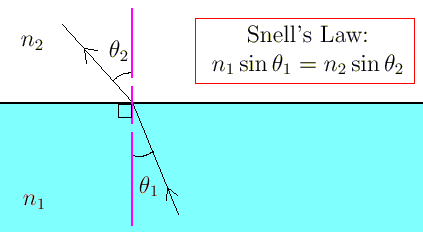
Principle of reversibility is a corollary of snells law-

Like with reflection, refraction also involves the angles that the incident ray and the refracted ray make with the normal to the surface at the point of refraction. Unlike reflection, refraction also depends on the media through which the light rays are traveling. This dependence is made explicit in Snell's Law via refractive indices, numbers which are constant for given media1.

Snell's Law is given in the following diagram.

Basic illustration of Snell's Law.

Multiple choice physics light : reflection and refraction from plane surface principle of reversibility of path of light image formation by plane mirror refractive index

Principle of reversibility holds true for

  1. Reflection

  2. Refraction

  3. Reflection and Refraction

  4. None of these

Reveal answer Fill a bubble to check yourself
C Correct answer
Explanation

Path of ray of light is reversible or light traces back it's path while traveling in reverse direction or a ray of light can pass in either direction along the same path.
So

Principle of reversibility holds true for both reflection and refraction.

Multiple choice physics light : reflection and refraction from plane surface principle of reversibility of path of light image formation by plane mirror refractive index

The _____________ states that light will follow exactly the same path if its direction of travel is reversed. Fill the appropriate answer.

  1. Newton's law of motion

  2. Laws of reflection

  3. Laws of refraction

  4. Principle of reversibility

Reveal answer Fill a bubble to check yourself
D Correct answer
Explanation

The principle of reversibility of light :-

Path of ray of light is reversible or light traces back it's path while travelling in reverse direction or a ray of light can pass in either direction along the same path

Note the directions of the arrow.

The beam of light travels back on the same path as it was traveling before the refraction and after the refraction after being encountered by the obstacle in the water.

Multiple choice physics light : reflection and refraction from plane surface principle of reversibility of path of light image formation by plane mirror refractive index

The refractive index of gias with respect to air is $3/2$ and that of water with respect to air is $4/3$. What is the refractive index of glass with respect to water?

  1. $9 : 8$
  2. $1 : 2$
  3. $2 : 1$
  4. $8 : 9$
Reveal answer Fill a bubble to check yourself
A Correct answer
Explanation

Given, 


Refractive index of glass=$\dfrac{3}{2}$


Refractive index of water=$\dfrac{4}{3}$

Refractive Index of glass with respect to water= $\dfrac{3/2}{4/3}$
                         =$\dfrac{9}{8}$

Multiple choice maths basic geometrical concepts and shapes construction of line segment and circle of given radius construction related to lines constructing line segment

A ray of light passing through the point A$(1, 2, 3)$, strikes the plane $x + y + z = 12$ at B on reflection passes through point C$(3, 5, 9)$. The coordinates of point B are 

  1. $(2, 5, 5)$
  2. $(-4, 6, 10)$
  3. $(-7, 0, 19)$
  4. $(0, -5, 17)$
Reveal answer Fill a bubble to check yourself
C Correct answer
Explanation
Let image of point $A(1,2,3)$ about $x+y+z=12$ be $D(p,q,r)$ then,
$\cfrac{p-1}{1}=\cfrac{q-2}{1}=\cfrac{r-3}{1}=-2\cfrac{1+2+3-12}{1^2+1^2+1^2} \\ D(p,q,r)=D(5,6,7) $

Line joining $CD$
$\cfrac{x-5}{2}=\cfrac{y-6}{1}=\cfrac{z-7}{-2}=\lambda$
Coordinate of $B(2\lambda+5,\lambda+6,-2\lambda+7)$
This lies on plane $2\lambda+5+\lambda+6-2\lambda+7=12 \Rightarrow \lambda=-6$
$B(2\lambda+5,\lambda+6,-2\lambda+7)=B(-7,0,19)$
Multiple choice chemistry pure substances and mixtures: separation of mixtures difference between mixtures and compounds pure substance and mixtures types of pure substances

The medium having same chemical properties in all directions is called :

  1. Isotropic medium

  2. Anisotropic medium

  3. Optically denser medium

  4. Light medium

Reveal answer Fill a bubble to check yourself
A Correct answer
Explanation

Isotropic medium is the one in which permeability and permittivity are unifrom in all directions,

hence, it is having same chemical properties in all directions.

Multiple choice physics some natural phenomena lightning conductors lightning safety advanced of lightning

An ordinary tube light used for lighting purposes contains :
  1. fluorescent material and an inert gas

  2. one filament, reflective material and mercury vapour

  3. fluorescent material and mercury vapour

  4. two filaments, fluorescent material and mercury vapour

Reveal answer Fill a bubble to check yourself
D Correct answer
Explanation

An ordinary tube light used for lighting purposes contains:

1. Two filaments
2. Mercury vapours
3. Fluorescent material

Option D is correct.